
VPN Protocols Explained: OpenVPN vs WireGuard vs IKEv2
Choosing the right VPN protocol can be confusing, especially when you see names like OpenVPN, WireGuard, and IKEv2 in your app settings with no clear explanation. Yet this choice can significantly affect your privacy, speed, and connection stability.
This guide, VPN Protocols Explained: OpenVPN vs WireGuard vs IKEv2, breaks down how each protocol works, what it is best for, and how to pick the safest option for your everyday internet use.
- What are VPN protocols and why do they matter?
- How OpenVPN, WireGuard, and IKEv2 work in simple terms
- OpenVPN vs WireGuard vs IKEv2: side-by-side comparison
- Pros and cons of OpenVPN, WireGuard, and IKEv2
- Real-world use cases: which VPN protocol should you use?
- Best practices and common mistakes when choosing VPN protocols
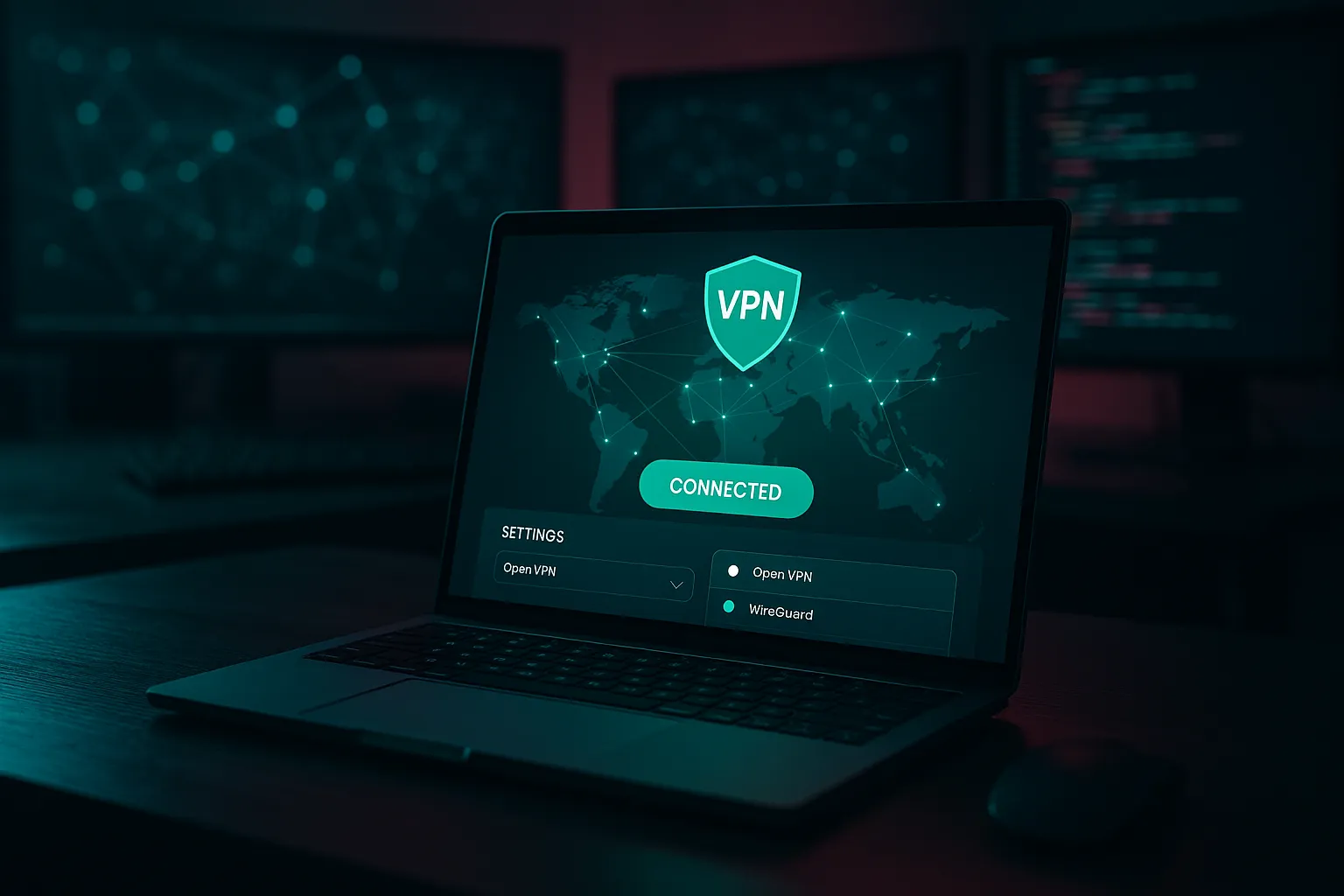
What are VPN protocols and why do they matter?
Simple definition of a VPN protocol
A VPN protocol is the set of rules that controls how your device and the VPN server talk to each other. It defines:
- How your data is encrypted
- How your device authenticates with the server
- How quickly data is sent and received
- How the connection recovers from drops or network changes
When you see options like OpenVPN, WireGuard, or IKEv2 in a VPN app, you are choosing which set of rules to use for your secure tunnel.
Why the protocol choice affects privacy, security, and speed
Different VPN protocols prioritize different goals:
- Security and privacy: Strong encryption and modern cryptography reduce the risk of interception or tampering.
- Speed and performance: Lightweight code and efficient design can give you faster downloads and lower latency.
- Stability and reliability: Some protocols handle weak Wi-Fi or mobile networks better than others.
- Compatibility: Not every protocol works on every device, router, or network (for example, some are easier to block by firewalls).
A VPN protocol alone cannot make you invisible online, but it is a critical part of a safer and more private connection.
Where you choose protocols in practice
Most modern VPN apps have an option like “Protocol” or “VPN technology” in their settings. You may see:
- Automatic (the app chooses based on your network)
- OpenVPN (sometimes with TCP and UDP options)
- WireGuard or a custom name for a WireGuard-based protocol
- IKEv2/IPsec
Understanding these options helps you tune your VPN for what you care about most: stronger security, higher speeds, or more reliable roaming on mobile.
How OpenVPN, WireGuard, and IKEv2 work in simple terms
OpenVPN: the battle-tested classic
OpenVPN is one of the most widely used VPN protocols. It is open source, which means its code is publicly available for security experts to review. That transparency has helped it earn a strong reputation.
Key traits:
- Uses robust encryption (commonly AES-256)
- Can run over UDP (faster) or TCP (more reliable on restricted networks)
- Works well on desktops, mobiles, and routers
- Can often bypass firewalls by using common ports like 443 (same as HTTPS)
The trade-off is that OpenVPN is relatively complex and can be slower than newer, more lightweight protocols on the same hardware.
WireGuard: the modern lightweight option
WireGuard is a newer protocol designed to be simple, fast, and secure. Its codebase is much smaller than OpenVPN, which makes it easier to audit and typically more efficient.
Key traits:
- Uses modern cryptographic primitives by design (no legacy algorithms)
- Very fast connection setup and reconnection
- Often delivers higher speeds and lower latency
- Integrated into many modern operating systems and kernels
WireGuard was originally designed with always-on connections in mind, which can raise some privacy design questions (for example, how long a server stores IP-to-key mappings). Many commercial VPN providers add their own privacy layers on top to address this.
IKEv2/IPsec: stable and mobile-friendly
IKEv2 (Internet Key Exchange version 2) is usually paired with IPsec for encryption. It is particularly good at handling changes in your network connection.
Key traits:
- Very stable when switching between Wi-Fi and mobile data
- Built into many operating systems (iOS, macOS, Windows, Android)
- Generally fast and efficient, especially on mobile
- Supports strong encryption suites
Because IKEv2 relies heavily on how each vendor implements it, security and privacy can vary more between providers compared to something like WireGuard, which is more standardized.
OpenVPN vs WireGuard vs IKEv2: side-by-side comparison
Security and privacy comparison
- OpenVPN:
- Very mature, widely audited, and considered highly secure when configured correctly
- Supports strong ciphers and perfect forward secrecy
- Flexible, but that flexibility means misconfiguration is possible on poorly managed servers
- WireGuard:
- Uses modern, opinionated cryptography with fewer configuration pitfalls
- Smaller codebase reduces attack surface
- Requires careful server-side design to avoid unnecessary logging of user IPs and keys
- IKEv2/IPsec:
- Can be very secure, but depends heavily on the exact implementation and chosen ciphers
- Some older or weak configurations still exist in the wild
- Closed-source implementations from certain vendors may be harder to audit
In practice, with a reputable VPN provider, all three can offer strong protection against casual snooping on public Wi-Fi and ISP tracking, but none can guarantee complete anonymity or protect against all types of tracking.
Speed and performance comparison
- WireGuard often delivers the best raw performance:
- Higher throughput for downloads and streaming
- Lower CPU usage, useful on phones and routers
- IKEv2 is typically close behind:
- Fast handshake and reconnection
- Good performance on mobile and unstable networks
- OpenVPN is usually slower:
- More overhead due to its flexible design
- Performance can vary depending on whether you use UDP or TCP and how the provider tuned it
Bypassing censorship and network blocks
- OpenVPN:
- Highly adaptable for obfuscation and stealth modes
- Running over TCP 443 can make it look similar to normal HTTPS traffic
- WireGuard:
- Uses UDP only, which can be easier for some networks to block
- Some providers add obfuscation layers, but it is less flexible than OpenVPN for this purpose
- IKEv2:
- Can be blocked on more restrictive networks
- Less commonly used for advanced obfuscation
Pros and cons of OpenVPN, WireGuard, and IKEv2
OpenVPN pros and cons
- Pros:
- Well-tested and widely trusted
- Highly configurable and flexible
- Good for bypassing many firewalls and filters
- Strong community and open-source ecosystem
- Cons:
- Slower than WireGuard and often slower than IKEv2
- More complex to configure correctly on the server side
- Can be heavier on battery and CPU on older devices
WireGuard pros and cons
- Pros:
- Excellent speeds and low latency
- Very quick to connect and reconnect
- Simpler codebase that is easier to audit
- Efficient on mobile devices and routers
- Cons:
- Requires careful privacy design by VPN providers
- Less flexible for obfuscation in difficult censorship environments
- Not supported by every older device or router firmware
IKEv2 pros and cons
- Pros:
- Very stable on mobile; handles roaming extremely well
- Fast connection setup
- Built-in support on many operating systems (no extra software needed in some cases)
- Cons:
- Security depends heavily on implementation and configuration
- Can be easier to block on restrictive networks
- Less flexible than OpenVPN for advanced custom setups
Real-world use cases: which VPN protocol should you use?
For streaming, gaming, and everyday browsing
- Best fit: WireGuard (or a WireGuard-based protocol)
- High speeds for HD or 4K streaming
- Lower latency for online games
- Good balance of performance and modern security
- Alternative: OpenVPN UDP
- Solid choice if WireGuard is not available on your device
- Works well for general browsing and streaming
For mobile users who move between networks often
- Best fit: IKEv2
- Maintains the VPN tunnel while you switch from Wi-Fi to 4G/5G
- Fast reconnection reduces interruptions
- Alternative: WireGuard
- Many apps now handle roaming well with WireGuard too
- Performance can be even better, depending on the provider
For travel, censorship, and restrictive networks
- Best fit: OpenVPN (with obfuscation if available)
- More options to disguise VPN traffic as regular HTTPS
- Often the most reliable when networks try to block VPNs
- Fallbacks:
- WireGuard or IKEv2 may work in some countries but are often easier to detect and block
Best practices and common mistakes when choosing VPN protocols
Best practices for safer, smoother VPN use
- Start with Automatic: If your VPN app has an “Automatic” protocol option, use it first. Good providers optimize this to balance speed and security for most users.
- Prioritize reputable providers: The protocol is only one part; how the provider implements logging, key management, and encryption matters just as much.
- Use WireGuard or OpenVPN for desktops: These usually give the best mix of performance and protection for laptops and PCs.
- Use IKEv2 or WireGuard on mobile: Especially if you move between networks frequently.
- Enable a kill switch if available: This prevents traffic leaks if the VPN connection drops, regardless of protocol.
Common mistakes to avoid
- Assuming any protocol makes you anonymous: A VPN protocol can encrypt your traffic and hide it from local observers, but it does not stop all tracking methods such as cookies, browser fingerprinting, or logged-in accounts.
- Ignoring provider documentation: Some VPNs tune their networks around a specific protocol. Always check their recommendations.
- Forcing TCP when not needed: With OpenVPN, TCP can help on very restrictive networks but often reduces speed compared to UDP.
- Using outdated or custom protocols without understanding them: Stick to well-known, audited options (OpenVPN, WireGuard, IKEv2) unless you have a clear reason not to.
Final thoughts: bringing it all together
With VPN Protocols Explained: OpenVPN vs WireGuard vs IKEv2, the key takeaway is that there is no single “best” protocol for every situation. Instead:
- Choose WireGuard for top performance on modern networks
- Choose OpenVPN when you need flexibility and better chances of bypassing blocks
- Choose IKEv2 for stable, roaming-friendly mobile connections
Combine a suitable protocol with a trustworthy VPN provider and sensible browsing habits, and you will significantly improve your online privacy and security without expecting absolute anonymity or perfect protection.